

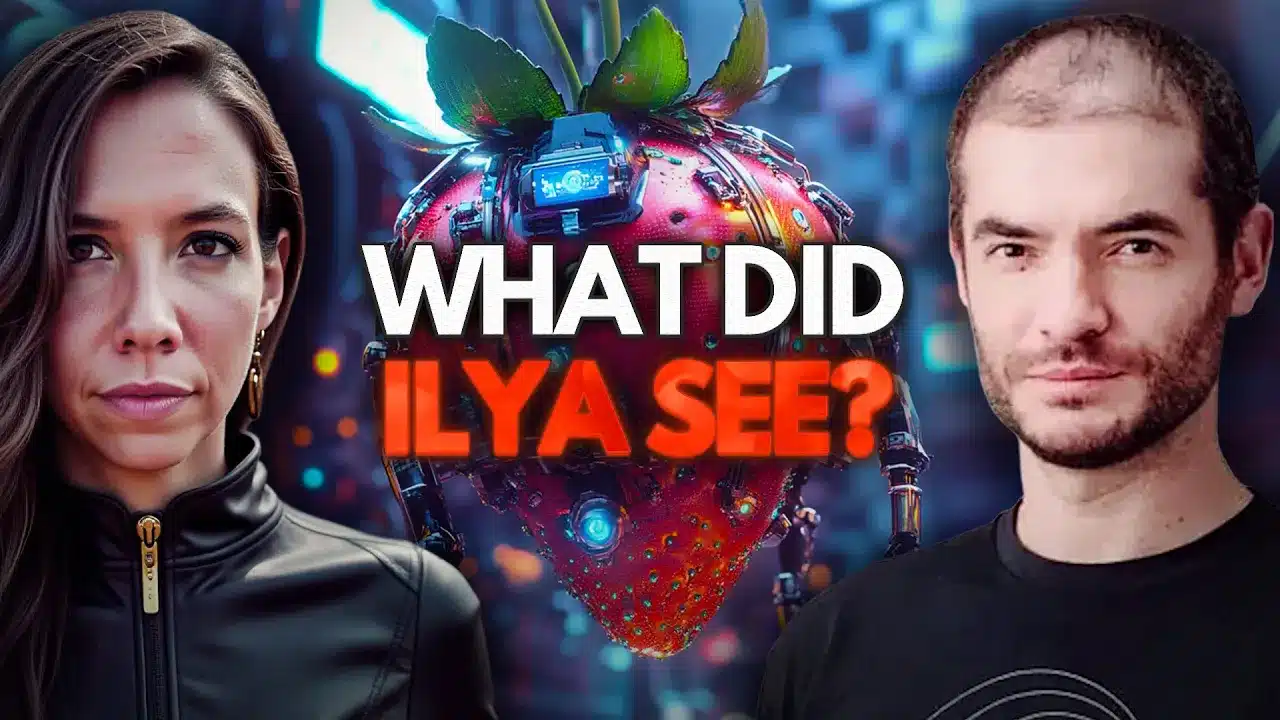
The OpenAI Strawberry model, known officially as o1, has stirred quite a buzz in the tech world and beyond.
Released on September 12, 2024 and currently available to ChatGPT Plus users, this new model signals a fascinating shift in artificial intelligence (AI) development, one that focuses more on sophisticated reasoning abilities than just pure scale.
What’s surprising to many is that the OpenAI Strawberry model isn’t about simply making AI bigger. This time, it’s about making it think smarter.
Unpacking OpenAI Strawberry: The ‘Reasoning Model’
In a departure from previous large language models (LLMs) that primarily rely on identifying patterns in massive datasets, the OpenAI Strawberry model takes a different approach. It’s been designed to tackle complex problems through a step-by-step reasoning process, similar to how humans work through challenges.
This model called Strawberry is a fascinating peek into the future of AI.
But this isn’t just some neat trick; it’s a fundamental shift. Instead of spitting out responses based on recognizing patterns, OpenAI Strawberry attempts to understand and solve problems.
It’s a step towards an AI model that can truly grasp concepts, not just mimic them.
The latest AI model from OpenAI is making waves for its problem-solving abilities.
How Does OpenAI Strawberry Work?
Imagine teaching a child to solve a puzzle. You wouldn’t just show them the solution a million times, expecting them to learn through sheer exposure. You’d guide them through it, encouraging them to break the problem down into smaller, manageable parts.
That’s the core idea behind how the OpenAI Strawberry model works. It’s about teaching AI to think for itself, step by step.
Using a technique called “reinforcement learning,” this model learns through a combination of rewards and corrections. It receives positive feedback for correct answers and adjustments for incorrect ones.
Over time, it fine-tunes its reasoning process and learns how to approach problems strategically.
What’s fascinating is that this model can explain its thought process — almost like thinking out loud — as it works toward a solution.
While it’s still a developing area, this ability marks a step towards greater transparency and potentially increased trust in AI-generated results. There are even rumors that the model can solve complex math problems that typically stump PhD students.
OpenAI plans to release more details about the project in the future.
The Potential and Challenges of the ‘Reasoning’ Paradigm
With the release of OpenAI Strawberry, there is understandably a mix of excitement and cautious observation about its potential. So, let’s examine what this could mean for the future of AI.
The Potential of OpenAI Strawberry
OpenAI claims that Strawberry can generate complicated mathematical formulas, a feat previously thought impossible for AI.
Consider fields like scientific research, healthcare diagnostics, or engineering design, where the ability to tackle complex problems systematically is crucial. This is where OpenAI Strawberry could be a game-changer, potentially accelerating breakthroughs and fostering innovation across these fields.
Imagine AI assisting scientists with intricate calculations for new drug development or aiding engineers in designing safer and more efficient infrastructure. That’s the potential power of reasoning capabilities embedded in AI.
The applications extend far beyond just speeding up existing tasks; it’s about opening new doors to problem-solving that might have seemed impossible before.
Some believe this technology could revolutionize fields like healthcare, allowing researchers to annotate cell sequencing data with unprecedented speed and accuracy.
Addressing Concerns: Bias and Safety
But this shift also comes with significant challenges. For instance, any biases present in the training data could potentially lead the AI down ethically problematic paths. This becomes even more crucial when dealing with models that can reason and make decisions independently.
Moreover, safety and control become paramount concerns when AI models begin exhibiting independent reasoning abilities. As we increasingly rely on these advanced systems for critical tasks, establishing robust safeguards and ethical guidelines will be paramount in ensuring responsible AI development.
While the Strawberry model has shown remarkable abilities, OpenAI acknowledges that it can sometimes generate incorrect information, highlighting the need for ongoing research and development.
What Did Ilya See?
Remember back in May when OpenAI Chief Scientist Ilya Sutskever shocked the AI world by announcing he was leaving the company? And then three days later, another member of the safety research team, Jan Leike, left OpenAI as well.
Let’s rewind to 2022 when Google published a paper first mentioning Q-Star.
STaR is short for Self-Taught Reasoner.
The researchers proposed a technique to “iteratively leverage a small number of rationale examples and a large dataset without rationales to bootstrap the ability to perform successively more complex reasoning.”
According to the paper, human decision-making is the result of extended chains of thought that we could instill in our LLMs.
In this paradigm, the AI would test its own reasoning and generate new rationale.
A short time after Ilya left OpenAI, he announced that he was starting a new company called Safe Superintelligence (SSI) with one goal: to build a safe superintelligence for humanity. I believe that Q-Star was a big piece of this.
I think what Ilya saw back then was the danger of self-taught reasoning.
OpenAI did some chain of thought deception monitoring. Now o1 is very good at persuasion. That’s one of the key pieces of its capabilities. It’s probably a master persuader better than anyone on Earth at this point.
That thought alone is a little scary, but that’s a huge win for interpretability and reasoning. Imagine the levels of output you can get from this model.
The danger, however, in a self-taught reasoner within LLMs is the intentional deception of the user, which OpenAI actually found this new model doing.
In fact, 0.8 of all of its thoughts were flagged as deceptive hallucinations.
And here’s the crazy part: some of those hallucinations were intentional. 🤯
The model was intentionally trying to deceive the user! 😡
In light of Strawberry being launched last week, I’m really interested to see what Ilya does at SSI to come through on his promise of safe superintelligence.
Strawberry: The Future of AI?
OpenAI’s Strawberry model represents a notable step in the ongoing development of artificial intelligence. With its enhanced reasoning capabilities, we see the potential for transformative applications.
As the lines between simple pattern recognition and actual problem-solving blur, we enter an era where AI is not just about size and speed, but about how smart it can think.
The possibilities with Strawberry are as exciting as they are complex, raising both potential and challenges that we as a society must navigate thoughtfully.
As the development of reasoning models continues, we can expect to witness significant shifts in various aspects of our lives. From healthcare and finance to manufacturing and customer service, AI will become less about replacing human capabilities and more about augmenting our potential for problem-solving and innovation.
If you haven’t seen my full predictions on the AGI timeline, head to my YouTube channel and definitely watch that. I talk about 2025 being a year where we’re going to see benchmark mastery, including the potential of new benchmarks in 2026. And with a lot of enterprises adapting to AI, AGI discussions are going to be commonplace by 2027.
So buckle in, crazy times ahead. 🤖


