Choosing an AI certification course in 2026 feels a bit like standing in the cereal aisle. Hundreds of boxes, super loud packaging, and every single one makes pretty promises to change your mornings.
I’ve watched this market expand from a handful of university programs into a crowded shelf of bootcamps, badges, and weekend credentials, and people ask me the same question almost every day.
Which one is genuinely worth my money?
Fair question, and I come at it from a strange angle. I built and sold a 100-writer content agency, and right up to the sale I was charging $1,000 an article while a $35 tool was quietly matching me. Then I spent the years since teaching thousands of professionals to put AI to work. So yes, I have opinions. Some have receipts.
A certificate is a passport, and passports are useful. The stamps still come from where you go with it. Plenty of programs sell you a lovely blue booklet and quietly skip the part where you learn to travel.
Here’s the answer before you scroll: for most people, the best AI certification is a $49 program you finish inside 2 weeks, followed by real money behind the one direction that survives. The gap between the cheapest and most expensive course on this page is $25,952, for the same subject.
Below I compare 11 well-known programs on price, time, and fit, then finish with straight recommendations for beginners, marketers, and business owners. Our own certification appears on this list, and I hold it to exactly the same standard as everyone else.
The 11 best AI certification courses at a glance
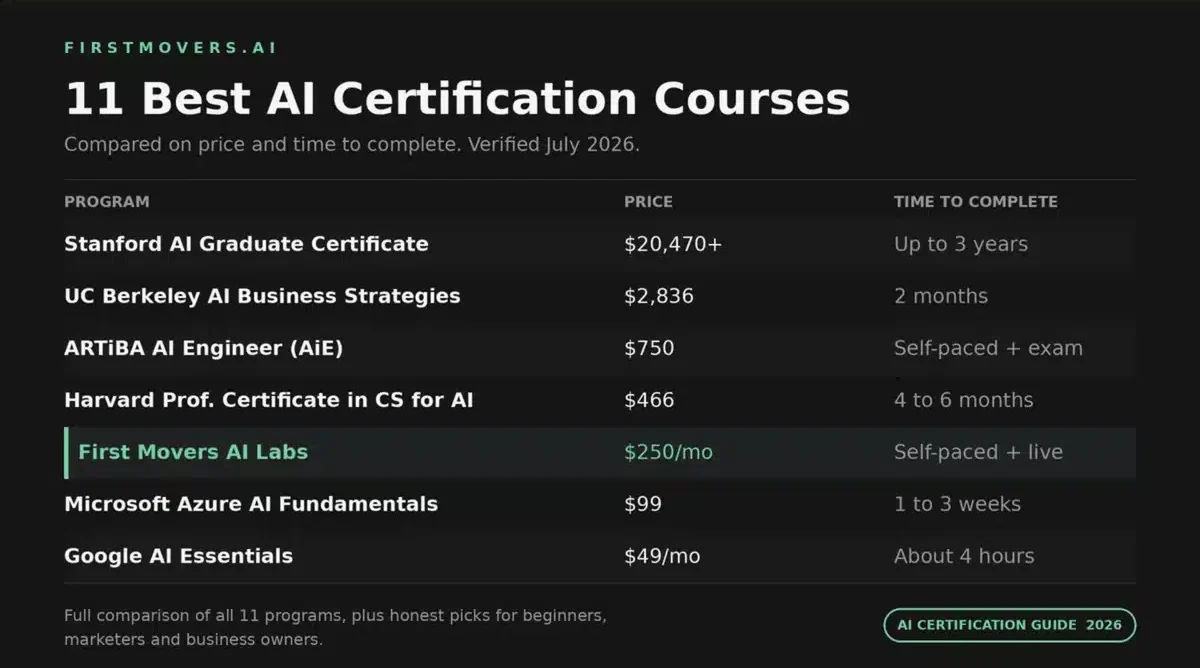
Here’s all 11 of the best AI certification courses side by side. 9 of the 11 run entirely as an AI certification online, and the 2 exam-based options let you study remotely and sit the test at a center or from home. Full reviews with a real strength and a real weakness follow further down.
| Program | Price | Time to complete | Best fit | Verified |
| First Movers AI Labs | $250/month, cancel anytime | Self-paced, weekly live sessions | Entrepreneurs and marketers who want AI running inside their business | Jul 2026 |
| Stanford AI Graduate Certificate | $21,086 to $25,952 | 4 courses within 3 academic years | Technical professionals who want an academic credential | Jul 2026 |
| Harvard Professional Certificate in CS for AI | $466 verified track | 4 to 6 months | Career changers who want programming foundations | Jul 2026 |
| IBM AI Engineering Professional Certificate | $49/month, or Coursera Plus | Under 4 months at 10 hrs/week | Aspiring AI engineers and developers | Jul 2026 |
| Google AI Professional Certificate | $49/month on Coursera | About 8 hours plus a capstone | Non-technical professionals who want applied AI fluency | Jul 2026 |
| Google AI Essentials | $49/month on Coursera, or Coursera Plus | About 4 hours | Office professionals adding AI to daily work | Jul 2026 |
| DataCamp AI Fundamentals | Free to start, Premium from $14/month annually | 9 hours | Complete beginners, zero coding | Jul 2026 |
| UC Berkeley AI Business Strategies | $2,836 promotional, $3,050 list | 2 months online, 4 to 6 hrs/week | Executives and decision makers | Jul 2026 |
| Microsoft Azure AI Fundamentals (AI-901) | $99 exam fee | 1 to 3 weeks of prep | Professionals in Microsoft and Azure environments | Aug 2026 |
| AWS Certified AI Practitioner | $100 exam fee, 50% off until 30 Sep 2026 | 30 to 40 hours of prep | Professionals in AWS-heavy companies | Jul 2026 |
| ARTiBA AI Engineer (AiE) | $750 one-time, all-inclusive | Self-directed study plus exam | Experienced tech professionals wanting vendor-neutral proof | Jul 2026 |
All prices and durations verified against the official program pages on 31 July 2026, with Stanford, Microsoft, Google and IBM re-checked on 1 August. Providers change pricing often, so confirm on the official page before enrolling.
Are AI certifications worth it in 2026?
Short answer for the skimmers. AI certifications are worth it for career changers, professionals in credential-driven industries, and self-taught people who need outside proof of their skills. They matter less for senior engineers with a portfolio of shipped work.
Now the longer, more useful answer.
The numbers first.
- McKinsey puts organizational AI use at 88 percent, up 10 points in a single year, with most companies applying it in at least one business function (McKinsey, The State of AI).
- PwC analyzed more than 1 billion job ads across 27 countries and found roles requiring AI skills now carry a 62 percent wage premium, up from 57 percent a year earlier (PwC 2026 Global AI Jobs Barometer).
- Those same jobs are growing 69 percent year on year against 9 percent for the wider market, and the ninth edition of the Stanford AI Index confirms AI skills claiming a rising share of postings market by market, well outside tech (Stanford AI Index Report 2026).
- The market underneath it all keeps compounding, with Grand View Research projecting roughly 36 percent annual growth through 2030.
So what does that mean for your resume?
Well, think back to when Excel stopped being something people proudly listed. At some point it became an expectation. Employers don’t get excited because you can build a pivot table anymore. They simply expect you to know how.
AI is at a similar point right now. Some employers already expect you to know how to use it, while others are only just starting to ask. Either way, a recognized certification gives you something concrete to point to. If your previous jobs don’t show much AI experience, it fills that gap before anyone even speaks to you.
And a 62 percent pay gap isn’t a rounding error. Money talks a lot louder than my opinion here, which is why the best AI certification for you depends far more on the move you’re making than on the brand printed on the paper.
Now here’s the part that cost me something to learn, and it’s the reason I keep telling people the paper is the smaller half of this.
From March to late May 2026 I deliberately ran my YouTube channel on AI with no training data behind it, just to see what the tools could do on their own. Monthly organic views fell from about 2 million toward half that. Roughly 2 months of recorded failures are still sitting on the channel, because I left them up.
The training data landed in early May. Median views grew 67x from February to May 2026. The cleanest pair, straight out of YouTube Studio: 3.2K views in 3 weeks without trained skills, 25.2K views in 3 days with them. Same channel, same audience, same week.
My verdict from that experiment, and I’ll stand behind it in any room: “AI is pretty horrible without a brain. You have to have a brain.”
A course teaches you the tools. What opened that 8x gap was the practice stacked on top of them. So AI certifications carry the most weight in three situations.
- You’re switching careers and need proof you can do something you’ve never been paid for.
- You work in an enterprise setting where formal credentials smooth approval.
- You’re self-taught and want an outside stamp on skills you already have.
Where do they carry less weight?
Senior technical roles, mostly. Put a certificate and a folder of shipped AI projects in front of a hiring manager and the folder gets opened first. AI certifications work beautifully as an accelerant. The engine is still the work you can show.
One more thing worth mentioning. AI certifications reward people who apply them inside a real commercial context. A certificate from 2024 sitting on a shelf is a souvenir. One you used to automate half your reporting last quarter is a raise.
How to choose an AI certification course
The short version. Match the format to your discipline, the depth to your goal, the brand to your industry, and the price to the career move. An AI certification for beginners should cost under $100 and take under a month. Everything past that should be a deliberate bet.
When I’m looking at an AI certification course, there are 5 things I always check before spending any money.
1. Start with the format. One of the biggest advantages of an AI certification online is working at your own pace. The downside is that it’s also very easy to stop halfway through. If you’ve got a graveyard of unfinished courses sitting in your account, look for a program with live sessions, deadlines, or a community that keeps you on track.
2. Then check what you’ll actually be doing. Some courses are mostly theory. You’ll spend your time learning how AI works and where it’s being used. Others get you building things from day one. Before you pay, think about which one you’d get more from.
3. The name matters too. A qualification from a university like Stanford will catch attention. A specialist provider might carry more weight in a specific industry. Neither is automatically better, so think about who’s going to be reading your resume.
4. Check when the course was last updated. AI changes far too quickly for old material to stay useful. If the last update was a couple of years ago, there’s a good chance parts of it are already out of date. Providers that refresh their content usually say so.
5. Finally, ask what you’re getting for the money. I’ve seen people squeeze far more out of a $50 course than a $5,000 certification. The price tag tells you what you’ll pay. It doesn’t tell you if you’ll finish it, or still be using what you learned 6 months later.
If you want to see how we teach this before you spend anything, our learn AI hub is free and it’s the best place to start.
1. First Movers AI Labs
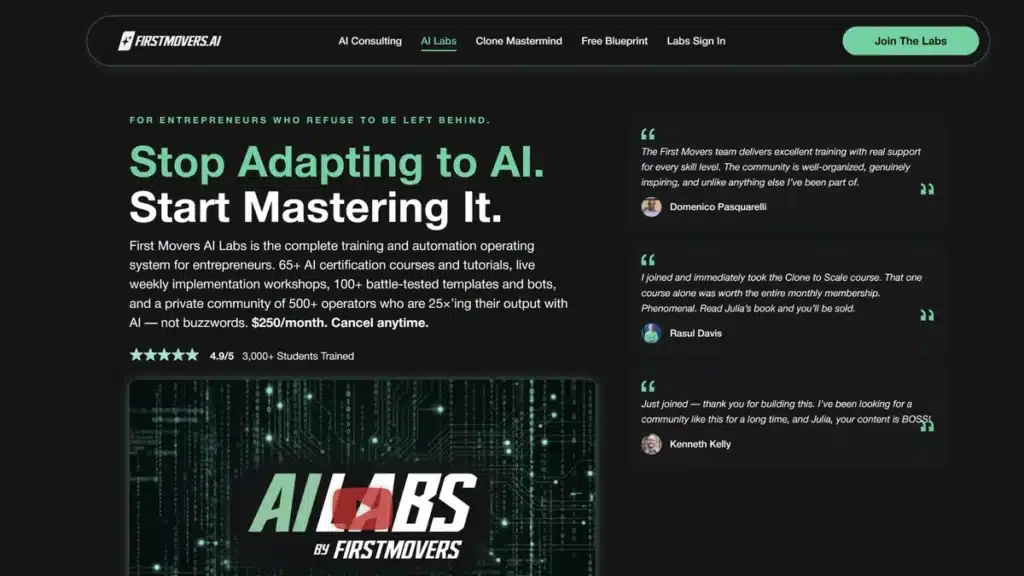
Price: $250 per month, cancel anytime
Time: Self-paced courses with weekly live implementation sessions
Best for: Entrepreneurs, marketers, and operators who want AI working inside their business now
Yes, this is ours, so let me tell you what it is and what it isn’t.
AI Labs is a membership platform we built from scratch. As of July 2026 it holds more than 65 certification courses and tutorials, weekly live training, over 100 templates and bots, and a private community of more than 500 operators putting AI to work in their own businesses.
The certification you earn here covers AI-driven communication and implementation, and everything in the curriculum comes from work we’ve done ourselves. Including the work that didn’t land. I spent 18 months building AI systems that wrote like a polite stranger before anything usable came out the other end. Scrapped clone footage. Skills that routed tasks to nobody. All of that is in the curriculum now, as the part where I tell you what to skip.
When a health crisis took me off camera for the better part of a year, my AI clone (her name is Dr. McCoy, and yes, she has better lighting than I do) carried our marketing and helped grow our channel past 290,000 subscribers. That experience shaped every framework we teach. I wrote in my agency days that more is never better, better is better, and a decade later I still grade every course we release against that line.
Where it falls short
This is a practitioner program, so if you want an academic credential with university letterhead, Stanford or Harvard below will be better for you. AI Labs suits people measured on output, and like a gym membership, the monthly model only pays off if you keep showing up. We built it that way on purpose. Certificates you finish and frame go quiet. Skills you practice weekly keep earning.
2. Stanford AI Graduate Certificate
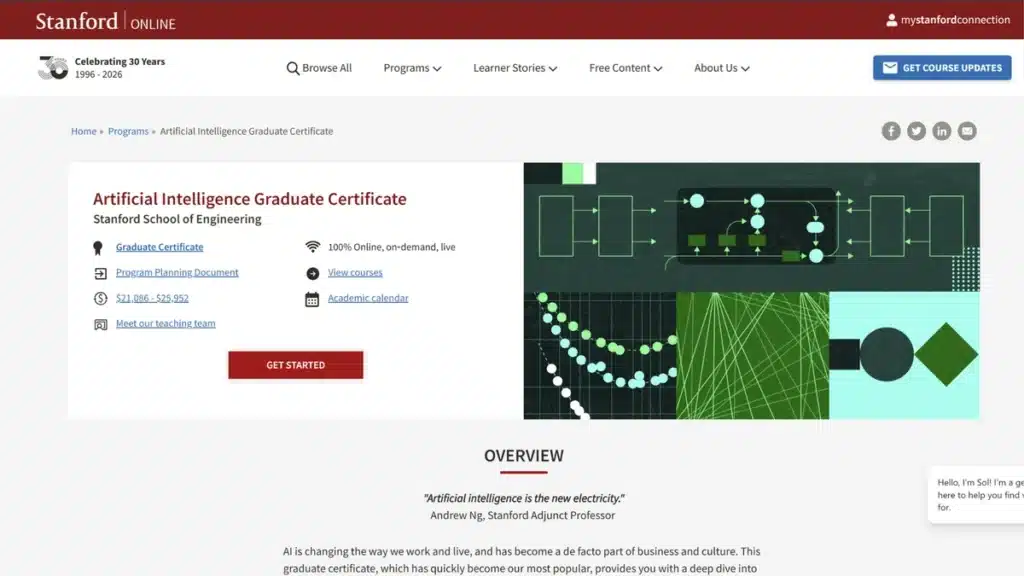
Price: $21,086 – $25,952 depending on course selection
Time: 4 graduate courses, completed within 3 academic years
Best for: Technical professionals who want the most prestigious academic credential in AI
Stanford is beautiful, prestigious, and genuinely hard. It’s the overachiever in this lineup, and it isn’t trying to be everyone’s favorite course…which is probably a good thing. It’s challenging, occasionally frustrating, and definitely not built for people looking for a quick certificate to stick on LinkedIn before lunch.
Stick with it, and you’ll come away with a much stronger understanding of how AI works underneath the tools. The fact that it’s Stanford doesn’t hurt either. Recruiters recognize the name long before they reach the end of the sentence.
You’ll find modules on neural networks, computer vision, and natural language processing, with much more depth than a typical online course offers. To put the price in context: the low end of Stanford’s range buys you 430 months of Google AI Essentials.
Where it falls short
Now the catch. The price, plus real prerequisites. You need strong math and programming before day one. Business professionals without a technical base will drown here, and cheaper routes to workplace AI competence exist all over this list.
3. Harvard Professional Certificate in Computer Science for AI
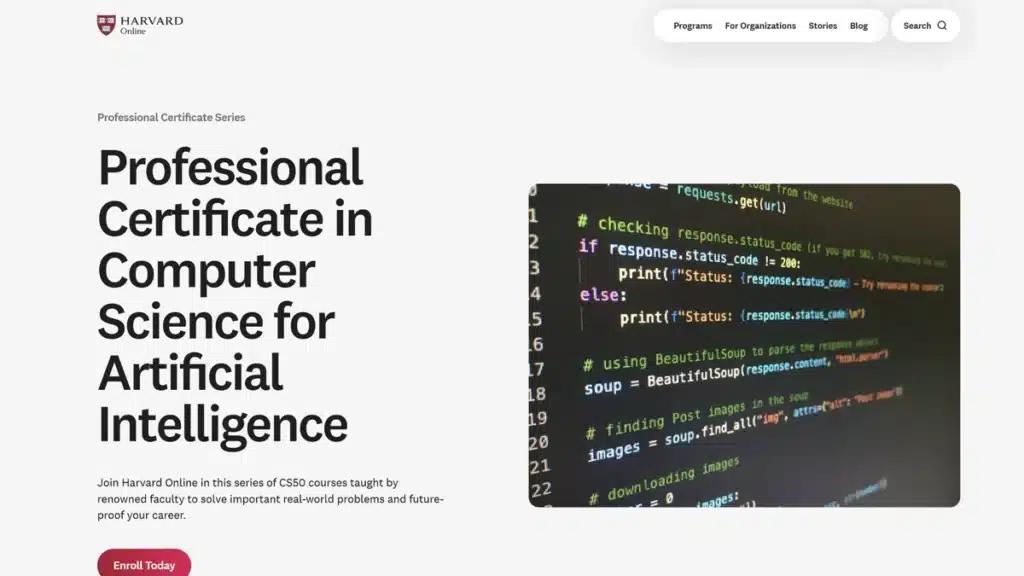
Price: $466 for the verified track
Time: 4 to 6 months typical completion
Best for: Career changers who want proper programming foundations underneath their AI skills
Harvard pairs its famous CS50 introduction with a dedicated AI course, so you build from first principles up to working systems, coding every project yourself. Measured on credential weight per dollar, this might be the strongest value here. Ivy League letterhead for less than a decent office chair, and roughly a sixth of what Berkeley charges.
Where it falls short
One thing to know first. This is a computer science program at heart. If your goal is using AI tools in marketing or operations rather than building them, the coding curve is a long way around.
4. IBM AI Engineering Professional Certificate
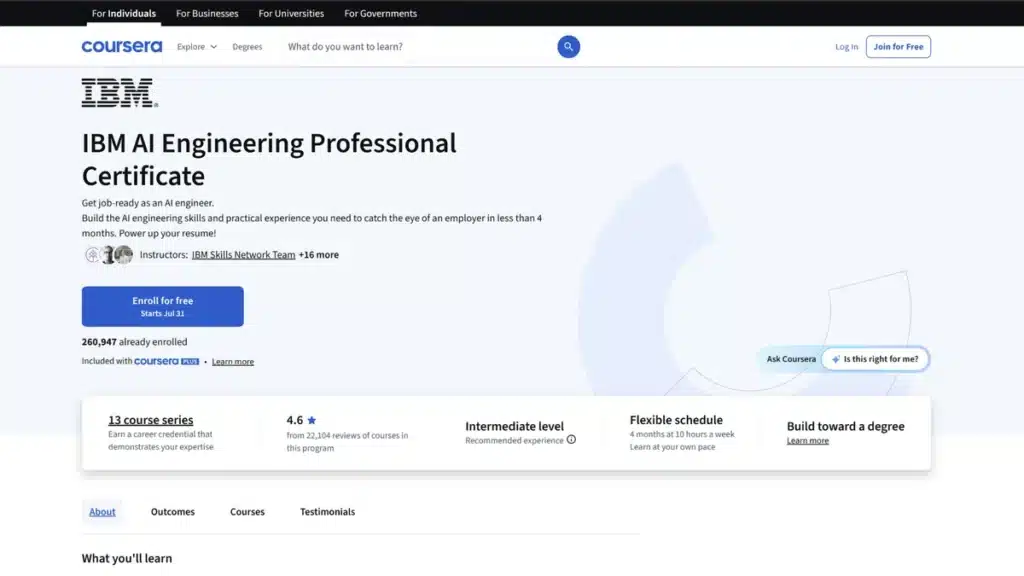
Price: $49 per month on Coursera, or included with Coursera Plus
Time: Under 4 months at 10 hours a week, per IBM’s own estimate
Best for: People who want to build machine learning models as a job
IBM has quietly assembled one of the most employer-friendly engineering pathways on Coursera. You build chatbots, train machine learning models, and finish with a small project portfolio plus a credential hiring managers recognize. The subscription pricing rewards fast finishers.
Where it falls short
Being totally honest, the curriculum leans on IBM tooling, so some skills transfer less cleanly elsewhere. And self-paced means self-discipline. If you’ve already got a graveyard of half-finished courses in your Coursera account, the price isn’t your problem.
5. Google AI Professional Certificate
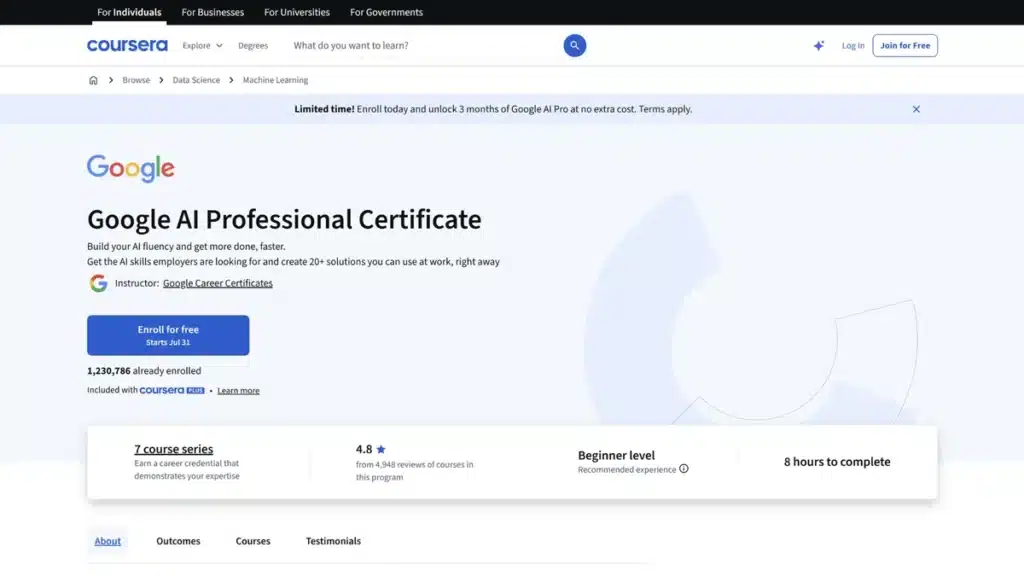
Price: $49 per month on Coursera. A limited-time offer currently bundles 3 months of Google AI Pro at no extra cost, so check whether it’s still running when you enroll
Time: 7 short courses totaling about 8 hours, plus a capstone
Best for: Non-technical professionals who want to move from knowing about AI to working with it daily
Google launched this in February 2026 as the step up from AI Essentials, and 1.2 million people have enrolled since. Google built the curriculum by analyzing real job postings with employers including Walmart, Deloitte, and Verizon, then wrapped it around more than 20 hands-on activities using Gemini, NotebookLM, and AI Studio.
You come out with a portfolio of actual work rather than a completion badge, which is exactly what the market rewards right now. US small businesses can currently access it at no cost, which is worth knowing if you run one.
Where it falls short
It’s newer than everything else here, so long-term career outcome data doesn’t exist yet. It’s also firmly inside the Google ecosystem, so if your workplace runs on Microsoft, the Azure route below may serve you better.
6. Google AI Essentials
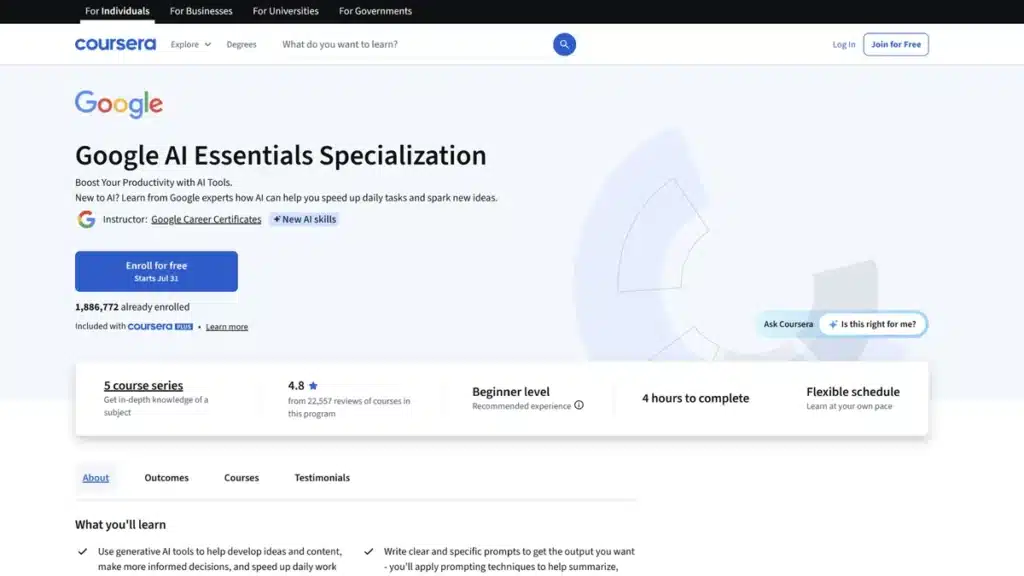
Price: $49 per month on Coursera, or included with Coursera Plus
Time: Around 4 hours
Best for: Office professionals who want AI folded into their daily work by Friday
Short, cheap, and genuinely useful. Google built this for the everyday professional, with heavy emphasis on prompting, tool selection, and responsible use. If AI education were coffee, this is the flat white. Small, well made, gets you moving.
Where it falls short
The trade-off? 4 hours gets you literate. Expert is a long way further down the road, and nobody is being hired into an AI role on this certificate alone. Think of it as the driving lesson.
7. DataCamp AI Fundamentals
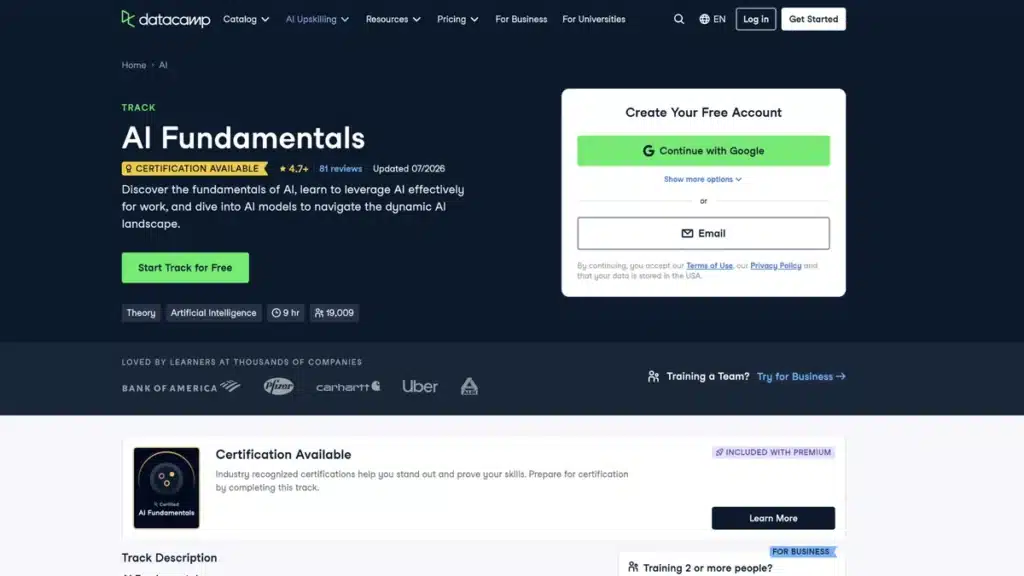
Price: Track is free to start. The certification sits behind Premium, from around $14 per month billed annually, or $35 month-to-month
Time: Around 9 hours
Best for: Complete beginners who want interactive learning with zero code
DataCamp does interactivity better than almost anyone, and I’ve lost entire evenings to their exercise loops. You learn machine learning, generative AI, and AI ethics through short exercises rather than passive lectures. No coding required at this level.
Where it falls short
Just know that fundamentals means fundamentals. The credential is light, and the subscription keeps billing after you finish, so cancel or commit to their deeper tracks. DataCamp also runs frequent promotions, so the price you see may not be the price next month.
8. UC Berkeley AI Business Strategies Certificate
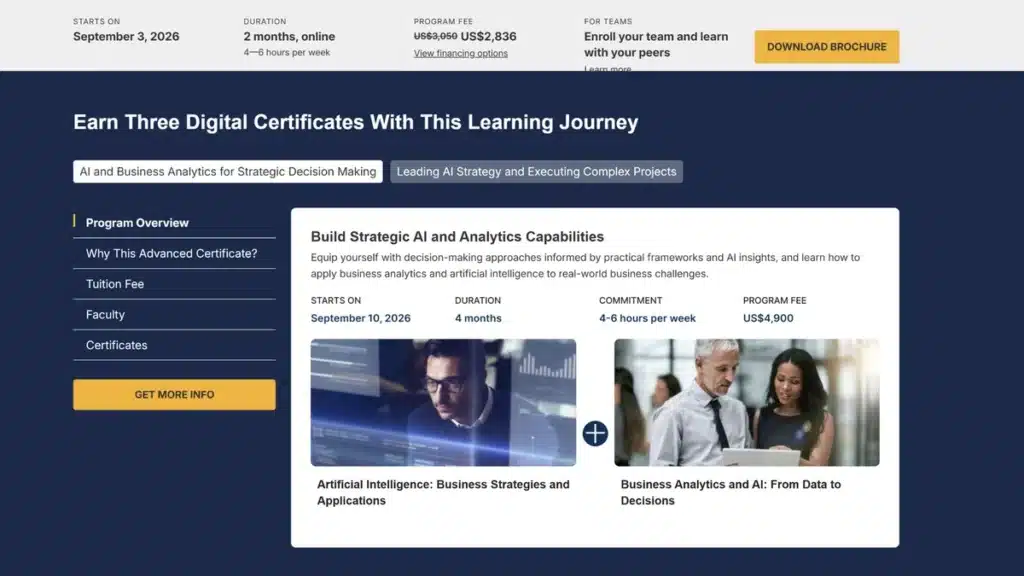
Price: $2,836 promotional, against a $3,050 list price. Cohorts start on rotating dates, so check what’s showing when you apply
Time: 2 months online, 8 modules, 4 to 6 hours per week
Best for: Executives and decision makers who approve AI budgets rather than write code
Berkeley built this for the boardroom. 8 modules, live faculty sessions, case studies from real deployments, and a capstone, ending in an executive certificate that plays well with senior peers. If your job is deciding where AI fits in a company, this speaks your language.
Where it falls short
The flip side. You leave with strategy and no hands-on skill. Operators who want to build get better value elsewhere on this list.
And two more things to keep in mind. One, the current price is promotional against a higher list price, so check what’s showing when you enroll. Two, the program is delivered on the Emeritus platform in partnership with Berkeley Executive Education, which is standard for executive education but worth knowing before you commit.
9. Microsoft Azure AI Fundamentals (AI-901)
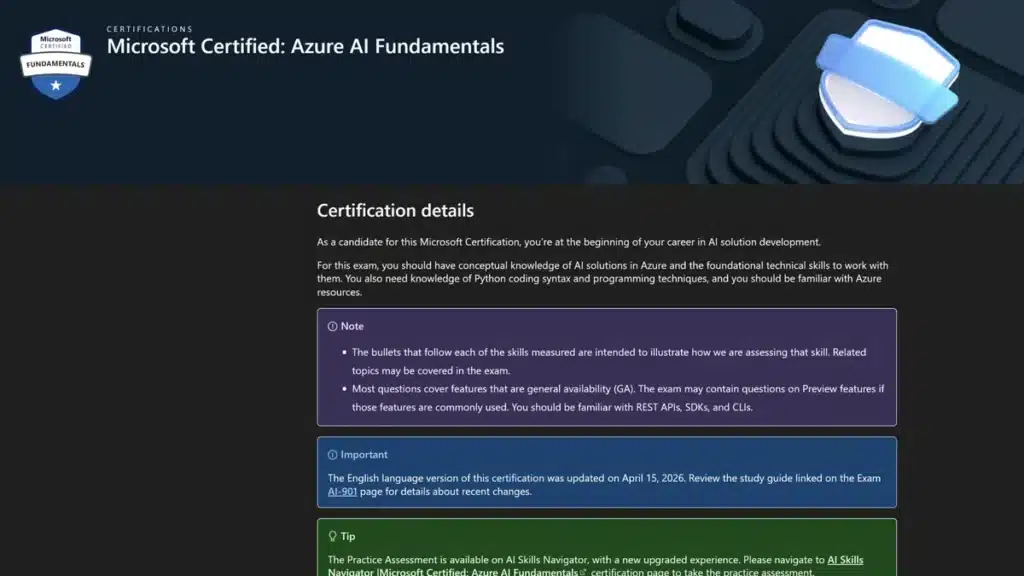
Price: $99 exam fee, with student and employer discounts available
Time: 1 to 3 weeks of preparation for most candidates
Best for: Professionals working inside Microsoft and Azure environments
Officially titled Microsoft Certified Azure AI Fundamentals, this is the credential your IT team already respects if your company runs on Microsoft. It covers AI workloads, machine learning principles, computer vision, natural language processing, and generative AI, all mapped onto Azure services your employer is probably already paying for.
Two things make it appealing. The exam fee is the entire cost, since Microsoft Learn provides the study material free. And the certification doesn’t expire, which is rare in this space.
Where it falls short
Heads up if you researched this one earlier in the year. The old AI-900 exam retired on 30 June 2026, and AI-901 is now the only version you can book. It expects some Python and a bit of familiarity with Azure resources, which makes it noticeably less beginner-friendly than the exam it replaced. If a study guide you found doesn’t mention AI-901, it’s out of date.
10. AWS Certified AI Practitioner
Price: $100 exam fee (exam code AIF-C01). AWS is running a 50 percent discount through 30 September 2026
Time: 2 to 6 weeks, or roughly 30 to 40 hours of preparation
Best for: Professionals in companies already running on AWS
A newer credential and a shrewd one. I nearly left it off, then remembered how much of the internet quietly runs on AWS. The exam validates foundational AI, machine learning, and generative AI knowledge alongside their cloud services, so the certificate maps directly onto infrastructure your employer already pays for.
Where it falls short
It’s vendor specific by design and tests knowledge rather than building skill, so pair it with something applied. The certification also expires after 3 years and needs renewing.
11. ARTiBA Artificial Intelligence Engineer (AiE)
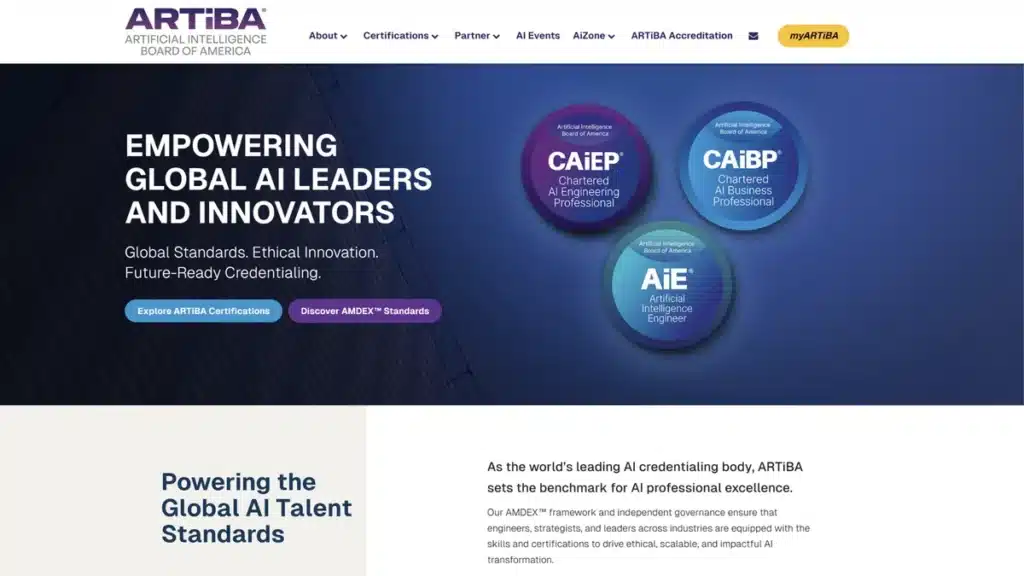
Price: $750 one-time, all-inclusive (fee revised November 2025)
Time: Self-directed study plus a proctored exam, credential valid 3 years
Best for: Working tech professionals who want vendor-neutral, exam-based validation
ARTiBA takes the professional body approach, closer to an accountancy qualification than a course. You prepare however suits you, then sit a proctored exam validating applied competency. The fee is genuinely all-inclusive, covering the study materials, one exam attempt, a digital badge, and a physical credential kit posted to you.
Worth knowing before you apply. There are real entry requirements, either a degree in computer science, data science or a related field, or a portfolio of AI systems you’ve actually shipped. You also need 2 to 3 years of hands-on technical experience and basic Python. This is validation for people already doing the work.
Where it falls short
The weak spot is name recognition, which trails the university and big tech options. The credential also expires after 3 years and needs renewing, which none of the vendor exams on this list require. Check that employers in your field respect it before you pay.
What about free AI certification courses
Short answer. Free AI certification courses are excellent for testing whether this field holds your interest, and lighter as proof for an employer.
Google runs free tiers through Google Skills, IBM SkillsBuild offers free credentials for students and career changers, and LinkedIn has a free generative AI course that displays right on your profile, where recruiters see it without you lifting a finger. Most Coursera programs can also be audited at no cost, though the certificate sits behind the paywall. US small businesses can currently get the Google AI Professional Certificate free, which is the most valuable freebie on this page.
As credentials, free AI certifications matter less, since hiring managers know there was no exam pressure and no skin in the game. A free certificate says curious. A paid one says committed. Employers can usually tell which is which.
So start free if budget is tight, then put money behind the direction you choose. People who treat learning as an investment behave like investors. They want a return, and they go and get one.
Red flags that should send you running
Short answer. Avoid any AI certification course that won’t tell you when it was last updated, won’t name its instructors, guarantees a salary, or hands you a certificate for watching videos.
The AI certifications market has attracted its share of cowboys, and the patterns are fairly consistent.
- Lifetime access with no update schedule. Generative AI moves quarterly, and any AI training program still teaching 2023 prompt engineering tricks is selling reheated leftovers. If nobody can say when the machine learning content was last refreshed, walk.
- Guaranteed salaries. No credential guarantees income, and a program willing to promise one will promise anything. The best AI certification programs also put named instructors front and center, because their people are the product. Faceless faculty means the course was assembled rather than taught.
- Certificates that only reward you for showing up. If all you had to do was watch a few videos, employers know that says little about what you can do. The stronger courses ask you to complete projects, pass assessments, or build something from scratch. That kind of evidence matters a lot more than a completion badge.
The best AI certification for 3 kinds of readers
Skip the agonizing. Here’s where I’d point you.
If you want an AI certification for beginners
The best AI certification for beginners in my book is Google AI Essentials, with DataCamp AI Fundamentals a close second. Both of these AI certification courses are cheap, short, and confidence-building.
Finish one within 2 weeks, then decide if the technical road (Harvard, IBM) or the application road (AI Labs, Google AI Professional Certificate, Berkeley) suits you better. Beginners who start with a $21,000 program almost always regret the order of operations.
Learn to swim in the shallow end. The deep end will still be there, and so will its invoice.
If you’re a marketer
First Movers AI Labs, and I say that with my cards on the table.
Marketing is where AI pays off fastest, and AI Labs was built around the content systems, automation, and clone workflows that carried our own company through its hardest year. One member, Adrian Skane, compressed roughly 700 hours of work down to 80, saving the $100,000 that would have been spent on consultants.
If you want to see the curriculum before committing, the course library is public, and the AI Labs page covers what membership includes. Pair it with the Google AI Professional Certificate if you want a big-name credential alongside the implementation work.
If you’re a business owner
Two roads. If you sign off on strategy, Berkeley earns its steep price. If you’re an operator who wants AI running your actual workflows, AI Labs gives you the templates, community, and weekly instructor access at a fraction of the executive education cost. Choose based on how hands-on your week is.
Questions people ask before choosing
Is an AI certification worth it with no tech background?
Yes, provided you pick the right tier. Google AI Essentials, the Google AI Professional Certificate, and DataCamp were all designed as an AI certification for beginners without technical backgrounds, and they get you conversational within a couple of weeks. Leave graduate-level programs like Stanford until you know the field holds your interest.
What is the best AI certification for beginners?
For most beginners, Google AI Essentials wins on price, speed, and name recognition. It runs about 4 hours and costs $49 a month on Coursera. DataCamp AI Fundamentals is the pick if you learn best through interactive exercises, and its track is free to start.
Can I earn an AI certification online for free?
You can. IBM SkillsBuild, LinkedIn Career Essentials, and several Google programs issue free credentials, and Coursera lets you audit most course content without paying. Paid certificates carry noticeably heavier weight with employers, so treat free options as your starting point.
Should I specialize in generative AI or start broader?
Broader first, then specialize. A general grounding keeps its value while individual tools change, and a generative AI credential makes a strong second certificate once you know your direction. Specializing first tends to lock you into a toolset before you know whether you enjoy the work.
How long does an AI certification course take to complete?
Anywhere from an afternoon to 3 years. Google AI Essentials runs about 4 hours, Harvard and IBM take 4 to 6 months, Stanford allows up to 3 academic years across 4 courses. Most AI certification courses aimed at working professionals land between 1 and 6 months.
Which AI certification do employers actually recognize?
Google, Microsoft, AWS, and IBM carry the widest name recognition because hiring managers already know those brands. University credentials from Stanford and Harvard carry the most weight in technical and academic settings. Practitioner programs are judged on the work you produce with them.
The best AI certification is the one you finish
The right AI certification course is the one matched to the move you’re making, at the price your situation can defend. And the finish rate has far less to do with the program than with the person who bought it.
One last warning from someone who has graded a lot of homework in this space. The certificate matters far less than the calendar you attach to it.
Pick a program. Block the hours. Finish the thing.
I watch our members ship things every week that they couldn’t have shipped 6 months ago. If you want that, AI Labs is where we do it, with me and the team in the room.