


The first time I showed my audience what it means to create an AI clone of yourself, I waited until the final 60 seconds to admit that the woman they’d been watching wasn’t me. That video went out in December 2024. It pulled the highest watch time of anything I’d ever posted, and people went back and rewatched the whole thing looking for the seams.
Would you have caught it? Most people didn’t, and that’s exactly the point.
Since then, my clone has fronted more than 500 videos I never filmed, part of the 750+ we’ve published on the channel. She grew my channel to 300,000+ subscribers and kept my business alive through the worst health crisis of my life. Her name is Dr. McCoy.
I want to hand you the whole build here. The tools I pay for, how the training works, what it costs each month, and the parts I got wrong the first time around.
What an AI clone actually is
An AI clone is a trained digital version of you. Your face, your voice, your gestures, and, when it’s built properly, your thinking. That last part gets skipped so often that I want to be specific about what a real clone involves.
You’re building 3 layers that have to work together. A visual layer, meaning a video avatar trained on footage of you. A voice layer, a cloned model built from recordings of your speech.
And a knowledge layer, an AI writing system trained on your ideas. Almost everyone stops after the first two, and you can feel it when they do. The face moves, the voice matches, and the words could belong to anyone. Mine sounds like me because roughly 100,000 words of my actual thinking sit underneath her. Frameworks, opinions, stories, teaching methods, all trained into the system that writes her scripts before she ever says a word.
I’ll also tell you upfront that my audience knows she’s a clone. I told them in that December video and I’ve been open about her ever since. My channel kept growing after people knew, and that settled the disclosure question for me permanently.
Check us out below, side by side!
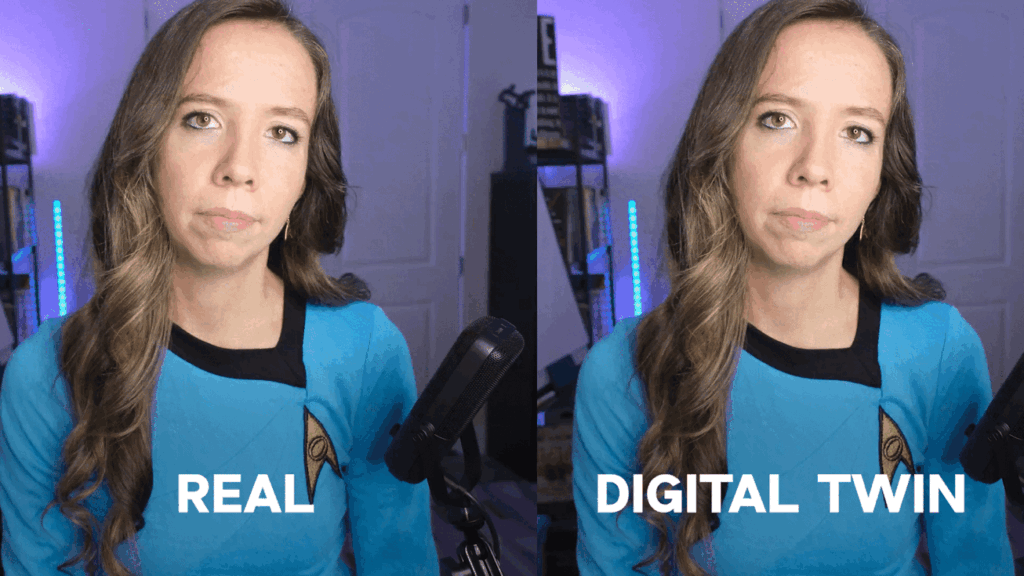
Why I cloned myself in the first place
In January 2025, my health collapsed. Five ER visits in a matter of weeks, my heart in fibrillation, the left side of my body feeling like it was shutting down, and no doctor able to tell me why. Sitting at a desk was hard, and filming was out of the question.
I’d finished training my clone right before it all hit. That still feels like providence to me. So I handed her the channel.
Growth tanked from 30,000 new subscribers a month to 3,000 almost as soon as she took over. The comments got rough. I kept publishing anyway because I had no other option.
Slowly, the audience came around. By July 2025 we were back near 30,000 new subscribers a month with several viral videos. We crossed 100,000 subscribers, and that same month Dr. Phil had us on his podcast, me and the clone both.
In November 2025, I committed to one video a day. The channel crossed 250,000 subscribers that January, and the climb from 200,000 took exactly 60 days. Today we’re at 300,000+.
Through that entire stretch, the operation behind the channel was 2 offshore video editors, 3 AI tools, and an hour or two of my time each week. That team, if you can even call it that, now serves a channel over 2 million people watch monthly. The clone content engine runs at a $3 million pace.
Underneath all of it is video, still the fastest place to build trust. HubSpot’s 2026 State of Marketing report found the 3 highest-return content formats are all video, with short-form out front.
Most founders I talk to already believe that. What stops them is production time, and that’s the whole reason the clone exists.
I wrote the full version of that stretch in the story behind the clone, if you want the why underneath all this.
The tools and people behind my AI clone
Claude writes her scripts. I trained it on years of my blog posts, courses, emails, and speech patterns until the drafts read like something I’d say on my best day. I call this my AI brain, and if everything else burned down tomorrow it’s the piece I’d rebuild first.
ElevenLabs holds my voice. A few minutes of clear, expressive audio taught it my cadence well enough that longtime viewers can’t pick the fake. The voice is the soul of the avatar, and once I got mine right the whole thing came alive.
HeyGen handles the visual side. It took my training footage and built an avatar that lip-syncs any script with natural head movement and expressions, in any outfit I filmed.
From there, my 2 offshore editors turn raw renders into finished videos with B-roll, captions, graphics, and thumbnails. The AI carries the volume, the editors carry the craft, and I carry the strategy. Nothing in the pipeline waits on me anymore, which used to be the whole problem.
How to create an AI clone of yourself in 5 steps
Ready to build your digital twin? Here’s the order I’d do it in, and the order matters more than most people expect.
Step 1. Record training footage the tools can learn from
Your clone learns from whatever you hand it, so this footage sets the ceiling on everything that comes after. Three to five videos, two to five minutes each. I shot five and I’ve never once wished I’d done fewer.
Record in 1080p at minimum, 4K if your camera does it. I used a ring light and a quiet room, nothing fancier than that, with the camera at eye level so I was looking straight down the lens the whole time. That eye contact carries into every video your clone ever makes.
Talk at your normal pace. Not slower, not more careful. The model copies whatever rhythm it hears, and a stiff sample gives you a stiff avatar for the life of the account.
Pick three to five outfits you’d actually wear on camera. Skip busy patterns and big logos, stay with colors that sit well under your lighting. Whatever you wear in these sessions becomes your clone’s permanent wardrobe, which is a sentence I wish someone had said to me before my first recording day.
Here’s a behind-the-scenes look at my videos on HeyGen

Notice how my outfits are clean, professional, and attractive?
Remember, your appearance in these training videos becomes your clone’s permanent wardrobe options.
Include natural hand gestures and facial expressions, but avoid repetitive movements that might appear randomly in your cloned content.
Show different emotions and energy levels to give your clone a full range of expressions to work with.
Step 2. Clone your voice before anything else
Start inside ElevenLabs and upload a few minutes of clear, expressive speech. Read something you actually wrote, in the tone you’d use on camera, and let the model hear your highs and your lows.
A monotone sample will get you a voice model that sounds like a GPS delivering a eulogy. Give it energy and it gives energy back.
Step 3. Build the visual avatar
Head to the avatar section inside HeyGen and upload your training videos one at a time. The platform checks each file for lighting and clarity before it processes anything, and it tells you when one falls short. Turnaround runs from under an hour to a few days depending on your tier and the queue.

Upload your prepared training videos one by one. HeyGen will analyze each video for quality, lighting, and clarity. Once it’s approved, pair it with your ElevenLabs voice. The face and the sound need to belong to the same person.

Don’t worry if the platform suggests improvements, you can always refine your clone later with additional training footage.
Step 4. Train the brain, the step everyone skips
Now open Claude and feed it your real body of work. Blog posts, video transcripts, emails, course material, the stories you tell on repeat. The model needs years of you, and mine had exactly that.
I tested this in not the best way. A video published without trained skills pulled 3.2K views in 3 weeks, and one published with them pulled 25.2K in 3 days. Same channel, same week, one difference: the brain.
I said it at the time and it’s still true. AI is pretty horrible without a brain.
If you ask an untrained AI to write like you, what comes back is the average of the internet with your name on it. Training on your actual material is different. The scripts start carrying your opinions and your way of explaining things.
So build the library and test every draft against your own ear. When a line reads like something you’d never say, correct it and tell the model why. Those corrections compound, and mine now has over 100,000 words of my thinking underneath it.
Step 5. Write a test script and generate your first video
Once your avatar is ready, it’s time to test your new digital twin. Click “Create Video” in the dashboard, then select “Avatars.”

Start with a short test script of thirty to sixty seconds. Write in natural, conversational language exactly as you would speak.

Include your name and some personal details to test how authentically your clone represents you.
Write numbers as words rather than digits – “twenty-five percent” instead of “25%.” Use paragraph breaks to create natural pauses in your clone’s delivery.
Avoid special characters or complex punctuation that might confuse the speech synthesis.
Click “Generate” and wait two to five minutes for processing. Download the result and review it carefully.

Check for natural lip-sync accuracy, realistic facial expressions, smooth body movements, and overall authenticity.
If something looks off, don’t sweat it. You can refine your approach by adjusting your script writing style.
Or create additional training videos to improve your clone’s performance.
Voila!
You’re ready to hand over 90% of the hard work to your digital twin.
How much does it cost to clone myself?
Under $160 a month. Most people brace for five figures when they ask me this, and the real bill barely covers a car payment.
ElevenLabs runs $22 on the Creator plan. HeyGen runs $29 on Creator, and the code FIRSTMOVERS20 takes 20% off. Claude sits anywhere from $20 to $100 depending on how much you produce, and I’d hold off on the Max plan until you’re publishing weekly.

Set that against the traditional route, where a single polished video eats 3 to 8 hours from script to publish. Hiring it out costs multiples of the entire monthly stack for one video.
This July, my clone brought in $5,700 in a single day while I sat by a river with my family. I stopped debating the math with myself somewhere around then.
Read this before you build yours
I want to prepare you for the rough patch, because I lived it. When I moved fully to my clone, growth dropped hard before it recovered. Some of those comments really stung.
Audiences need a minute to adjust. They do adjust, as long as the content keeps earning their attention.
I also want to warn you about some of the guides floating around, because a few of the paid ones teach workflows that don’t exist. One claims you can hand a script to a video tool and receive a polished 8-minute video in one pass.
I’m in production on a 30-second AI sketch right now. Those 30 seconds have taken days of takes, a start frame for every shot, and a cleanup pass in Premiere. These tools generate a few seconds at a time, so an 8-minute video means 60 to 100 separate generations.
Anyone teaching otherwise has never shipped one.
And decide your disclosure stance before you publish. Your audience will eventually ask. I’m fully public about Dr. McCoy, and the viewers who stayed once they knew turned out to be the viewers who buy and stick around.
I’d make that trade again every time.
Your message is the asset, the clone just multiplies it
AI will never make weak content strong. It scales whatever you hand it, thin message included, and volume makes weaknesses louder.
One of the bigger names running ads against us shows lifetime stats of 8.5 million views and 48,000 subscribers in the ad itself. Our channel earned 24.8 million organic views and gained 304,000 subscribers in less time. Same technology, wildly different outcomes, and the gap is the message underneath the avatar.
I spent close to 2 years sharpening mine before Dr. McCoy existed. That’s the real price of a clone that sounds like you, the thinking you feed it.
It transfers, too. Kimberly Kubitza, who runs Shiloh Wholistic Wellness Center, watched her clone land her first client within weeks of flying home from our build, off one short video, and the message in it was simply hers and true.
If you’d rather build all of this with people who’ve already done it, that’s exactly what Clone Mastermind, our AI consulting builds, and AI Labs are for. I also went deep on how AI consulting for small business works and ranked the best AI certification courses, if you want to read around first.
Questions I get about AI clones
Do I need technical skills to create an AI clone of myself?
No. The tools are consumer products with guided setup, and if you can record a video on your phone and upload a file, you can do this. The genuinely hard part is the thinking layer, and that’s knowledge work.
How long does the whole setup take?
Plan on 2 to 3 hours of your own working time. Recording takes 30 to 60 minutes, account setup a bit more, and the rest goes to your first scripts. Platform processing runs from under an hour to a few days, and the ElevenLabs voice clone usually finishes in under an hour with clean audio.
Is it legal to clone myself with AI?
Yes. You own your likeness and you’re giving consent, which makes your own clone fully legal. Cloning anyone else without written permission is a different story and a serious one, so read the platform terms.
Will people be able to tell it’s a digital clone?
With strong training footage, most viewers can’t. Mine kept growing a channel now at 300,000+ subscribers. I disclose anyway, because audiences will forgive the technology a lot faster than they’ll forgive feeling tricked.
How much does it cost to clone yourself each month?
Under $160 a month on the stack I use. ElevenLabs Creator at $22, HeyGen Creator at $29 with the code FIRSTMOVERS20 for 20% off, and Claude from $20 to $100 depending on how much you produce.
What languages can my clone speak?
HeyGen translates avatars into dozens of languages, which opens your content to audiences you’d never reach filming manually. The most natural output still comes from the language of your training footage. The model learned your accent and rhythm there.
Do I actually own my clone?
When you build it the way I’ve laid out here, yes. Your avatar lives in your HeyGen account, your voice in your ElevenLabs account, and your AI brain in your Claude workspace. Every piece stays yours no matter which subscriptions you keep or cancel.
Your turn to create an AI clone of yourself
So go create an AI clone of yourself. Record the footage and clone the voice this weekend, then give the brain the time it deserves. That layer decides whether your clone sounds like you or sounds like everyone.
The first time she publishes while you’re at dinner with your family, you’ll understand why I never went back. My free Blueprint lays out the exact system, the one that grew this channel to 300,000+ subscribers without a single day of filming.


