The AI revolution isn’t just changing industries—it’s completely reshaping education. A recent McKinsey study found that 78% of organizations are now using generative AI. This explosive growth isn’t slowing down.
AI education isn’t just about teaching people how AI works. It’s about using AI tools to enhance learning, preparing students for an AI-powered workforce, and helping educators leverage these powerful technologies to create more effective, personalized learning experiences.
Why does this matter right now? Because we’re facing a skills gap of epic proportions.
Students who understand AI principles will have an insurmountable advantage in tomorrow’s job market. Professionals who can harness AI tools will outperform those who can’t by orders of magnitude. And educators who master AI-enhanced teaching methods will deliver learning experiences that were simply impossible before.
The future belongs to those who can navigate this new AI landscape—not just as passive consumers, but as skilled creators, critical thinkers, and innovative problem-solvers.
Are you ready to join the AI education revolution? Let’s dive in.
The Expanding Universe of AI Education
AI education operates in two distinct but complementary dimensions. First, there’s teaching about AI—the fundamental concepts, ethical considerations, and technical skills that power today’s AI revolution. Then there’s teaching with AI—leveraging intelligent tools to enhance learning experiences across all subjects, from literature to physics.
The beauty of AI education? It spans every educational level imaginable.
In K-12 classrooms, young students are exploring basic AI concepts through gamified learning platforms and simple coding exercises. These digital natives are building AI literacy from the ground up—recognizing how algorithms shape their daily experiences on social media and streaming services.
Higher education institutions are diving deeper, offering specialized degrees in AI engineering, data science, and machine learning. Universities are racing to develop comprehensive AI curricula that balance technical mastery with crucial ethical frameworks.
Vocational training programs have pivoted quickly, integrating AI modules that prepare workers for technology-augmented careers in healthcare, manufacturing, and customer service—areas where AI is already transforming day-to-day operations.
Meanwhile, corporate learning environments are investing heavily in upskilling programs that cover practical applications like:
- Machine learning models that predict consumer behavior
- Natural language processing tools that streamline communication
- Robotics systems that optimize supply chains
- Computer vision technologies that enhance quality control
The most effective AI education programs don’t just focus on coding algorithms—they emphasize critical thinking about how these powerful tools reshape our world, for better or worse.
Unlocking the Game-Changing Benefits of AI Education
AI education isn’t just another trend—it’s completely transforming how we teach and learn. The benefits are immediate, measurable, and frankly, revolutionary.
Truly Personalized Learning at Scale
Gone are the days of one-size-fits-all education. AI-powered learning platforms now adapt in real-time to each student’s unique needs. These systems analyze learning patterns, identify knowledge gaps, and automatically adjust content difficulty—creating truly personalized pathways that were logistically impossible before.
A struggling student receives additional practice problems precisely where needed. An advanced learner gets challenging material that prevents boredom. Each learner progresses at their optimal pace, not the average speed of the classroom.
24/7 Intelligent Tutoring That Never Tires
AI tutoring systems are becoming increasingly sophisticated, providing instant feedback and guidance whenever students need it. These digital tutors can:
- Explain complex concepts in multiple ways until understanding clicks
- Identify misconceptions early before they become entrenched
- Answer thousands of questions without fatigue or frustration
- Provide emotional support and encouragement through natural language processing
The result? Students receive immediate help exactly when motivation is highest—not days later when papers are returned.
Administrative Freedom Through Automation
Let’s be honest—administrative tasks drain valuable teaching time. AI tools are now handling these mundane burdens, automatically:
- Grading objective assignments and providing detailed feedback
- Scheduling classes and organizing resources
- Detecting potential plagiarism cases
- Managing attendance and participation records
When educators are freed from paperwork, they can focus on what matters most: meaningful human interaction with students.
Data-Driven Insights That Transform Teaching
The most powerful benefit might be the unprecedented visibility into learning processes. AI systems generate rich data that reveals:
- Which concepts students struggle with most
- Which teaching methods prove most effective
- When engagement peaks and wanes
- How different students learn best
These insights allow educators to make evidence-based decisions rather than relying on intuition alone—transforming teaching from an art to a science without losing the human touch that makes great education so powerful.
How to Get Started in AI Education Today
The AI education landscape is evolving rapidly, but there’s never been a better time to jump in. Whether you’re a student eager to learn, an educator looking to upskill, or a school administrator planning curriculum shifts, practical entry points exist at every level.
For Students: Your AI Learning Pathway
The good news? You don’t need an expensive degree to begin your AI education journey. Start with these accessible options:
Free courses provide excellent foundations. Khan Academy’s computer science and statistics sections build crucial prerequisite skills. Google’s AI Education resources offer beginner-friendly introductions to key concepts without overwhelming technical details.
When you’re ready to go deeper, platform-based learning delivers structured progression:
- Coursera’s AI For Everyone by Andrew Ng explains core concepts in plain language
- edX’s Introduction to Artificial Intelligence from IBM requires no prior coding experience
- Udacity’s AI Programming with Python combines foundations with practical skills
For those ready to invest more seriously, specialized bootcamps like AI4ALL and Lambda School offer intensive, career-focused training that prepares you for real-world applications in months rather than years.
For Educators: Becoming an AI-Savvy Teacher
The most successful educators aren’t waiting for formal requirements—they’re proactively developing AI literacy through multiple channels:
Professional development programs specifically designed for educators are emerging rapidly. Microsoft’s Educator Center and Google’s Teacher Center both offer free AI-focused certification paths that emphasize practical classroom applications.
Educator communities provide crucial support during implementation. Join ISTE’s AI in Education Network or the AI4EDU Slack channel to connect with peers facing similar challenges and share successful strategies.
Hands-on experimentation remains the most effective teacher. Start small by incorporating one AI tool into your existing lessons—whether it’s using Grammarly to improve student writing or Wolfram Alpha to enhance math instruction.
For Businesses: Harnessing AI Education for Competitive Advantage
The AI revolution isn’t just transforming education—it’s completely reshaping business. Companies that develop AI literacy across their workforce aren’t just keeping pace; they’re actively creating insurmountable advantages against competitors still caught in traditional thinking.
Business leaders, entrepreneurs, and professionals across all industries can and should pursue AI education. This isn’t about becoming data scientists—it’s about understanding how AI transforms your specific business challenges and opportunities.
The Business Case for AI Education
Forward-thinking companies are discovering that AI-educated teams:
- Make better strategic decisions informed by AI capabilities
- Identify automation opportunities that reduce costs
- Develop AI-enhanced products and services that customers love
- Communicate effectively with technical AI specialists
These advantages explain why business-focused AI education isn’t a luxury—it’s a survival requirement in 2026.
First Movers AI Labs: The Fast Track for Business Leaders
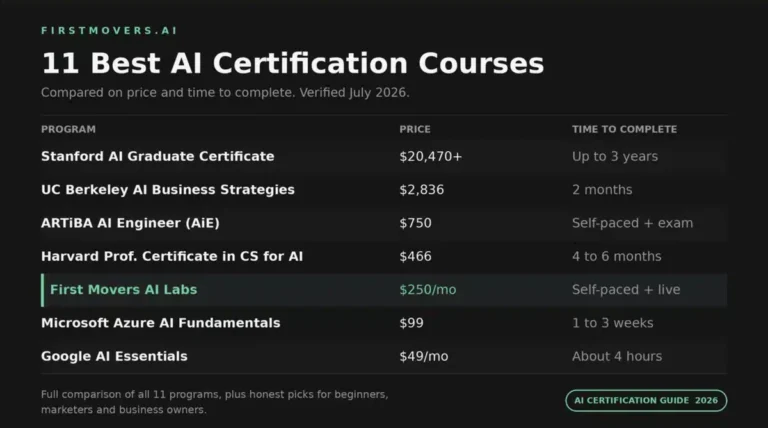
For executives and entrepreneurs serious about leading in the AI era, First Movers AI Labs offers specialized training designed specifically for business applications.
Unlike technical programs that focus on coding, First Movers AI Labs emphasizes strategic implementation—teaching you exactly how to identify high-value use cases, evaluate AI solutions, and implement them for maximum ROI.
Their signature program combines live expert coaching, real-world case studies, and practical implementation planning. Participants don’t just learn about AI—they develop concrete strategies for their specific business challenges while building a network of like-minded leaders navigating similar transitions.
Additional Learning Pathways for Business Professionals
Beyond specialized business programs, these courses offer valuable perspectives for professionals:
AI Business School by Microsoft delivers executive-level insights through masterclass videos and case studies. This resource focuses on developing an AI strategy, responsible AI implementation, and cultural transformation—perfect for leadership teams needing strategic frameworks without technical complexity.
Artificial Intelligence: Business Strategies and Applications from Berkeley Executive Education takes a deeper dive, providing structured learning about machine learning applications in marketing, finance, and operations. This paid program requires a bigger investment but delivers university-backed credentials that signal serious commitment to AI literacy.
The businesses that thrive in the coming decade won’t be those with the biggest AI budgets—they’ll be those whose leaders deeply understand how to apply these powerful tools to their specific challenges and opportunities.
The Future of AI in Education: What’s Coming Next
The AI education landscape we see today is just the beginning. The next wave of developments will make current implementations look primitive by comparison. Here’s where we’re headed—and why it matters for learners, educators, and institutions.
Hyper-Personalized Learning Environments
Future AI education systems will move beyond simple adaptive pathways to create truly individualized learning universes. These systems will:
- Adjust not just content difficulty but teaching methodologies based on each student’s unique cognitive profile
- Incorporate real-time emotional and attention data from facial recognition and biometric feedback
- Seamlessly blend virtual and physical learning spaces based on what works best for each concept
- Create custom curriculum sequences that optimize for both short-term engagement and long-term retention
The one-size-fits-all classroom is becoming as obsolete as the one-room schoolhouse.
AI Teaching Assistants That Feel Human
The gap between AI tutors and human educators is narrowing rapidly. Next-generation systems will feature:
- Sophisticated emotional intelligence that detects frustration, confusion, or disengagement
- Natural conversation abilities that make interactions feel genuinely supportive rather than mechanical
- Cultural awareness that adapts communication styles to diverse student backgrounds
- Creative problem-solving capabilities that generate novel explanations tailored to individual learning styles
These AI assistants won’t replace human teachers but will amplify their impact—handling routine questions while educators focus on complex guidance and inspiration.
Immersive Simulation-Based Learning
Traditional theoretical education is giving way to experiential learning powered by AI and mixed reality:
- Medical students will practice surgery on AI patients that react realistically to every decision
- Engineering students will design and test virtual prototypes with AI-simulated physical properties
- History students will converse with AI representations of historical figures
- Business students will negotiate with AI-powered virtual stakeholders in realistic scenarios
This shift from knowing to doing will fundamentally transform how we assess competency and readiness.
Continuous Assessment Replacing Traditional Testing
The era of high-stakes testing is ending as AI enables ongoing, unobtrusive evaluation:
- Learning systems will analyze thousands of micro-interactions to build comprehensive competency profiles
- Natural language processing will assess deeper understanding through conversational exchanges
- Project-based assessments will be evaluated against increasingly sophisticated rubrics
- Creativity and critical thinking will be measured through AI analysis of problem-solving approaches
This evolution means students spend more time learning and less time proving they’ve learned.
The future of AI in education isn’t just about technology—it’s about fundamentally reimagining what’s possible in learning. The institutions and individuals who embrace these transformations early won’t just adapt to change—they’ll actively shape it.
The question isn’t whether AI will transform education, but how quickly and how completely. Those who position themselves at the forefront of this revolution will define learning for generations to come.
Embrace the AI Education Revolution—Starting Today
AI education isn’t just another educational trend—it’s a fundamental shift in how we learn, teach, and prepare for the future. We’ve explored how AI is creating personalized learning experiences, providing 24/7 intelligent tutoring, automating administrative burdens, and offering unprecedented data-driven insights.
Whether you’re a student, educator, school administrator, or business leader, the path forward is clear: AI literacy is no longer optional—it’s essential.
The future belongs to those who understand both the capabilities and limitations of these powerful tools. Those who embrace AI education now will help shape its development rather than merely react to changes as they come.
Take your first step today. Enroll in a course. Implement an AI tool in your classroom. Evaluate how AI could transform your business. Then share this post with others who need to understand the AI education revolution that’s already underway.
The future of learning is here—and it’s powered by AI.
Book your strategy session with First Movers to architect your AI-driven future today.