AI SEO is everywhere. And everyone’s got an opinion.
“AI content is trash!” scream the traditionalists.
“AI is the future of content!” shout the tech bros.
Meanwhile, you’re sitting there wondering: Does AI content actually rank on Google?
Here’s the thing. Google doesn’t care if a robot or a human wrote your content. It cares about one thing: Does your content help people?
But that’s where it gets tricky.
Most AI content is generic. Boring. Written for everyone and no one. It reads like it came from a content farm (because it basically did).
Yet some AI-assisted content is crushing it in search results. The difference? Strategy.
In this guide, we’ll dig into what actually works when combining AI and SEO. No fluff. No theories. Just real tactics for using AI without tanking your rankings.
Does AI Content Hurt Your SEO Rankings?
Google’s official stance is clear: AI content won’t get penalized. As long as it follows E-E-A-T guidelines (Experience, Expertise, Authoritativeness, Trust), you’re good to go.
Here’s proof:

Sounds simple, right?
Not so fast.
Here’s where things get messy. E-E-A-T is deeply tied to unique human perspectives. Real experiences. Personal insights. The stuff that makes content genuinely valuable.
AI doesn’t have a bad day at the office. It’s never struggled with a difficult client. It hasn’t spent years mastering a craft through trial and error.
It also doesn’t do unique research. It doesn’t step into offices to do interviews. It hasn’t struggled, found a brand-new solution, and won on its own.
And that’s a problem.
Because the content that ranks best? It’s written by people who’ve been there, done that, and have the battle scars to prove it.
How Does AI Content Actually Perform?
Here’s where things get interesting.
Despite all the doom and gloom, well-crafted AI SEO strategies can absolutely deliver results in search rankings. The key word? Well-crafted.
A recent report shows AI-generated content takes around 2-3 months to rank in search engines. That’s virtually identical to human-written content. Translation: Google’s algorithms don’t discriminate based on who (or what) wrote your content.
But there’s a massive caveat.
Most AI content sucks. And Google knows it.
The problem isn’t that AI SEO gets penalized. It’s that most AI content deserves to be penalized. Generic, surface-level fluff that could apply to any business in any industry? Yeah, that’s not ranking anywhere.
The AI Content That Actually Works
The brands crushing it with AI SEO aren’t just hitting “generate” and calling it a day. They’re using AI strategically.
For high-volume, structured content: Product descriptions, meta tags, social media posts. AI excels here because the format is predictable and the information is straightforward.
For research and ideation: AI can analyze competitor strategies, suggest topics, and identify content gaps faster than any human. It’s like having a research assistant that never sleeps.
For overcoming creative blocks: Stuck on an intro? Need five different angles for the same topic? AI delivers options in seconds.
But here’s what separates winners from losers in AI SEO: human oversight.
The Strategic Approach That Works
Smart marketers treat AI like a powerful intern. Great at gathering information, terrible at making strategic decisions.
They use AI to handle the grunt work—research, first drafts, keyword analysis. Then humans step in to add the secret sauce: unique perspectives, real experiences, brand voice, and strategic thinking.
This hybrid AI SEO approach delivers the best of both worlds. The efficiency of AI with the authenticity of human insight.
The numbers back this up: A Sprout Social survey found that 71% of marketers using AI report positive outcomes. But notice what they’re not saying—they’re not replacing humans. They’re augmenting them.
Where AI Content Falls Short
Even with human oversight, AI SEO has blind spots that can hurt your search performance.
Factual accuracy: AI confidently states “facts” that are completely wrong. Google’s algorithms are getting better at detecting this, and factual errors can tank your credibility.
Lack of depth: AI excels at covering the basics but struggles with nuanced analysis. It can tell you what happened, but not why it matters.
Generic perspectives: Without unique insights, your content becomes part of the noise rather than cutting through it.
Outdated information: AI training data has cutoff dates, meaning it might miss recent developments in fast-moving industries.
The brands winning with AI SEO understand these limitations and plan accordingly. They fact-check everything, add unique angles, and keep content updated with fresh insights.
How to Integrate AI SEO Into Your Content Strategy
Ready to stop fumbling around with AI and start using it strategically?
Here’s your roadmap for building an AI SEO strategy that actually works.
Start With High-Volume, Low-Risk Content
Not all content is created equal. And not all content needs your personal touch.
Perfect for AI:
- Product descriptions
- Meta titles and descriptions
- Social media captions
- Email subject lines
- FAQ answers
Why these work? The format is predictable. The information is straightforward. And honestly, nobody’s looking for your life story in a product description.
Meta proved this works at scale. They doubled their monthly search traffic using AI-powered SEO tools to target non-branded keywords. They also used AI for website audits—fixing broken links, missing metadata, and slow page speeds.

The result? Massive traffic growth with minimal human intervention.
Use AI as Your Research Powerhouse
This is where AI SEO gets really powerful.
AI doesn’t get tired. It doesn’t get bored. And it can analyze competitor strategies, search trends, and content gaps faster than any human team.
Here’s how to do it:
Competitor analysis: Use AI to scrape competitor blogs and identify content gaps. What are they missing? What questions aren’t they answering?
Keyword research: Let AI find long-tail opportunities and search pattern changes you’d never spot manually.
Content auditing: AI can analyze your existing content performance and suggest improvements faster than any human review.
The key? Use AI to gather intelligence, then let humans make strategic decisions with that data.
The Hybrid Content Creation Method
This is where successful AI SEO strategies separate from the failures.
You’re not replacing human creativity. You’re amplifying it.
Step 1: AI handles the grunt work
- Research and data gathering
- First draft creation
- Keyword analysis and optimization suggestions
Step 2: Humans add the magic
- Unique perspectives and insights
- Personal stories
- Strategic positioning and messaging
- Fact-checking and quality control
A single topic can be covered in so many different ways. Choosing the right approach depends on your audience, your product, market conditions, and competing content. That strategic thinking? That stays human.
Build Transparency Into Your AI SEO Process
Here’s something most brands get wrong: they try to hide their AI usage.
Bad move.
Kimberly Huang from Litmus recommends being transparent about AI use. Her team actually includes lines like “This email was written using Jasper” in their newsletters.
Why does this work? Trust.
Your audience isn’t stupid. They can often tell when content is AI-generated. Being upfront about it actually builds credibility, especially when you’re clearly adding human value on top.
Focus on Thought Leadership Content
While AI handles the operational stuff, double down on human-driven content that builds genuine connections.
Invest human time in:
- Original research and case studies
- Podcasts and video content
- Expert interviews and commentary
- Industry analysis and predictions
Then use AI to amplify this content across channels. Repurpose your podcast into blog posts, social content, and email campaigns.
Monitor and Prune Ruthlessly
AI SEO isn’t set-it-and-forget-it.
Userpilot learned this the hard way. They had to prune 847 blog posts, many of which were AI-generated. The content was low-converting, low-traffic, and outdated.
After removing the dead weight? 16% traffic boost and their highest-ever visitors count.

Your maintenance checklist:
- Regular content audits to identify underperforming AI content
- Fact-checking for accuracy
- Updates to keep information current
- Quality reviews to ensure content adds real value
The brands winning with AI SEO treat it like a garden, not a factory. They plant strategically, tend carefully, and prune ruthlessly.
The Bottom Line: AI SEO Is Here to Stay (But Most People Are Doing It Wrong)
Let’s cut to the chase.
AI SEO works. The data proves it. The case studies prove it. The results prove it.
But here’s the uncomfortable truth: too many businesses are completely botching their AI implementation.
They’re treating AI like a magic content machine instead of a strategic tool. They’re pumping out generic fluff and wondering why their rankings tank. They’re cutting corners on the human elements that actually make content valuable.
Meanwhile, the smart brands are quietly using AI SEO to crush their competition.
They’re not just keeping up—they’re pulling ahead. While their competitors debate whether AI is “good” or “bad,” these first movers are building systems that deliver results.
The First Mover Advantage
Here’s what I learned when I sold my 100-person agency in 2021: being early to AI isn’t just an advantage—it’s survival.
People called me crazy. “AI will never replace writers as good as you,” they said.
When ChatGPT launched, those same people faced an existential crisis. Their businesses, built on purely human processes, were suddenly at risk.
The difference? I saw the wave coming and positioned myself to ride it instead of getting crushed by it.
The same thing is happening with AI SEO right now.
Most businesses are still figuring out basic prompts. While they’re stuck in analysis paralysis, forward-thinking companies are building AI SEO systems that deliver massive competitive advantages.
Ready to Stop Guessing and Start Winning?
If you’re serious about mastering AI SEO—not just dabbling with ChatGPT prompts—you need proven frameworks, not trial and error.
That’s exactly why I built First Movers R&D AI Labs.
It’s the world’s first comprehensive AI implementation community designed for professionals who want to lead the AI revolution, not just react to it.
Inside AI Labs, you get:
- 40+ expert-led video courses covering advanced strategies, including my proprietary GEO (Generative Engine Optimization) framework
- Weekly live coworking sessions where you implement what you learn with real-time feedback
- 40+ battle-tested AI bots built specifically for content creation, SEO optimization, and workflow automation
- Access to my AI clone for on-demand coaching and strategy guidance
- Over 100 downloadable resources, templates, and implementation blueprints you won’t find anywhere else
This isn’t another surface-level AI course. These are the exact systems I use to help businesses build sustainable competitive advantages through strategic AI implementation.
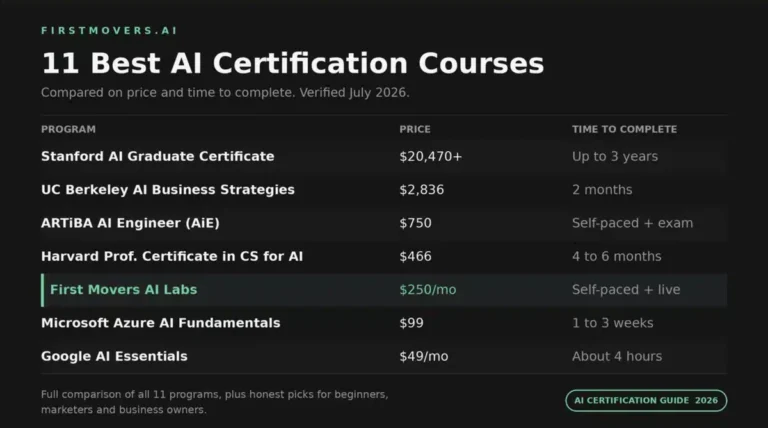
The investment? Just $250/month—less than $9/day to future-proof your business.
The alternative? Keep guessing. Keep making expensive mistakes. Keep watching your competition pull ahead while you figure it out the hard way.
Ready to become a First Mover?
Join AI Labs today and start building AI SEO systems that actually work.
Because in 12 months, there will be two types of businesses: those who mastered AI early, and those scrambling to catch up.
Which one will you be?